


BELITSA
Location – 18 km south of the municipal center Tutrakan, 4 km southeast of the village of Preslavtsi and 4 km north of the village of Varnentsi.
Old name: There is no old name. There are three main versions of the origin of the name. The first is that it comes from the oath of the Turks expelled in 1878, who said to themselves during their deportation: “Belyasız kalmason”, which meant: not to leave without trouble, without misfortune. Thus, the curse of the village “belyasız” was reflected in the name Belitsa. The second version derives the toponym from its first settler Belcho or white Zlati. According to the third version, the name Belitsa was derived from the white soil on the slope where its inhabitants were settled. The first version is arbitrarily made up and has no objective basis, because the village bore its name even before the Liberation. It cannot be established with certainty since when a village with the name Belitsa existed, but it can be said with certainty that it has not known any other name, remaining unchanged in its historical development.
Population according to censuses over the years:
1881 – 624 people
1888 – 755 people
1893 – 830 people
1900 – 1044 people
1905 – 1191 people
1910 – 1308 people
1934–1521 people
1941 – 1518 people
1946–1545 people
1956 – 1152 people
1985 –1067 people
2000 –788 people
2011 – 594 people
2022 – 438 people
First information
During field archaeological research, sites from the Eneolithic period were registered near the village of Belitsa. The appearance of permanent settlements, which formed a settlement mound in the Eski Dere area near the village of Belitsa, in this small area, on the hill to the north, about two kilometers from the current village, was the settlement from the Eneolithic period. Their habitation dates back to the Kodjadermen-Gumelnitsa-Karanovo VI Culture 4000 – 3500 BC.
The size of the settlement cannot be determined because the terrain has been plowed and the terrain features have been erased, but undoubtedly, like all settlements located on high ground from that time, it was fenced with a hedge and clay, and the dwellings in it were very dense and without courtyards. Artifacts have been discovered – flints, ceramic fragments of vessels, bone objects from the first population groups that inhabited the territory around Tutrakan.
The Getae tribe lived in Northeastern Bulgaria. Like all Thracians, they were farmers and sheep breeders, but they were also distinguished by their horse breeding. The Getae buried their dead in mounds and in ordinary graves, according to their social status. They burned the corpse and placed the ashes in an urn. Thracian burial mounds have been found in the land of the village of Belitsa. The largest group, consisting of four mounds, is east of the village, in the Ireka area. North and northwest of the village are four more mounds, located on both sides of the asphalt road. All the mounds found in the land of the village of Belitsa are cultivated and are threatened with extinction due to plowing. The settlement to which those buried in the mound belonged was probably west of the Futula area, on the slope of the Buyuk Para area.
Ludogorie and the Tutrakan region fell under Turkish rule in 1388. There were Bulgarian settlements around the medieval fortress of Taraka (Tutrakan), and probably one of them was the village of Belitsa. There is scant information about the history of the region from the following centuries.
Belitsa during the Renaissance
At the beginning of the 19th century, the village was located two kilometers south of the current location of the village in the Yurtluka area. In 1810, Russian troops passed by the village when Gen. Zass attacked and captured Tutrakan on May 19, 1810.
Written information about the village of Belitsa is the map of the military operations of the Russian army in 1828-1829, included in Lukyanovich’s work “Description of the Turkish War 1828-29”. There, along the Tutrakan-Razgrad road, the village is marked under the name “Belizana” and is the only village with a Bulgarian name.
It is not known exactly when the settlement moved to its current location, but a widespread legend says that the old inhabitants fled the Yurtluka area due to the appearance of many snakes. The large, yellow snakes would come out on the slopes, plow the fields, and even appear in the courtyards.
The reason for choosing the new place of residence was the presence of springs, which were later captured into fountains.
Around 1840, there were 12 Bulgarian houses in the village, located next to the kulak, the valley to the right of the stream. There were also about 60 Turkish houses in the Turkish neighborhood, southeast of the Kulak neighborhood. It is assumed that the Bulgarians came first, and then the Turks, fleeing the plague. They also built a mosque, which existed until 1934.
In a special map of European Turkey, published in German in Leipzig in 1876, the village is again marked on the road from Tutrakan to Razgrad, but under the name “Belestar”. According to local historian Boris Iliev, the origin of the name is from white earth, white soil, which is found on the slope on which the settlement is located.
The village is also mentioned under the name Belitsa in the diary of Ivan Karshovski, secretary of the Panayothitov detachment.
The troubles of the Bulgarian population, both in the surrounding villages and in Belitsa, continued after the suppression of the April Uprising and even intensified after the declaration of the Russo-Turkish War of Liberation in the spring of 1877. The Circassians from the surrounding villages and the closest to them, Kuzgun (Antimovo), were especially distinguished. The Circassians seized and killed not only those they met on their way, but also those who were in their homes.
Belitsa after the Liberation
With the Liberation of Bulgaria in 1878, Belitsa began a new stage in its history. Emigration and migration movements of people began. Few Turkish families emigrated from the village of Belitsa, since during the war they did not commit atrocities against the Bulgarians. Only some nobles and rich families emigrated, since their lands, which had been given to the Bulgarians as a sharecropper, were now being contested by some of the peasants who had occupied them, and they could not lead the same luxurious lifestyle. Bulgarians settled in the homes of these Turks, in the Turkish neighborhood. Bulgarians from the Balkans settled in the places of the emigrated Turks. The main livelihood of the local population was agriculture and animal husbandry. In addition to the necessary for the farm – oxen, horses, cows and buffaloes, many sheep were also raised, for wool and meat.
Pubs, small shops, and a barbershop opened their doors in the village.
In the first days after the Liberation, the Bulgarians took power. The villagers elected Atanas, son of the distinguished grandfather Krastyo Halacha during the Revival, as mayor. The position was honorary, without any payment, and Atanas Krastev held this position for 20 years. He protected the interests of the village. Disputes arose between Belitsa and the neighboring village of Denizler (today the village of Varnentsi) over land and forest. In 1910, when the mayor of Denizler was Varban Raev, the village of Belitsa seceded and became an independent municipality with the constituent village of Karamehmedler (Brenitsa). The first mayor of the newly formed municipality was again Atanas Krastev Halachev, who held this position until March 1911, and the mayor of the municipality was Yordan Petrov Chakarov.
The beginning of the Bulgarian Agricultural People’s Union (BAZNS) was laid in the village of Belitsa, where the first agricultural friendship of the BAZNS in the district was established. It had 7 members in the spring of 1900 and remained the only one in the district until 1903.
After the Allied War and the Treaty of Bucharest signed on July 28, 1913, Southern Dobrudja passed into the borders of the Kingdom of Romania. During the Romanian occupation, Belitsa was administratively part of Durostor County (Silistra).
Construction of military fortifications near Tutrakan begins. The local population is forced to work on them for free. In 1914, construction of the Belitsa – Tutrakan road begins.
On the eve of World War I, the people of Beli, as well as residents of other villages, began to leave their homes and flee to Bulgaria, not only because of forced unpaid labor, hard labor, but also to avoid military service in the Romanian army.
On September 1, 1916, Bulgaria declared war on its “treacherous neighbor” Romania. On September 1-2, 1916, units of the 3rd Bulgarian Army crossed the Dobrudja border from the Danube to the Black Sea.
During the epic battle for Tutrakan (September 5-6, 1916), the village’s residents were evacuated south so as not to suffer.
From June 27 to November 14, 1917, the newspaper “Dobrudzha” published in Babadag searched for, compiled and published a detailed list of names of the kidnapped Dobrudzians, distributed under the name Martyrology of the Dobrudzian Princes. These lists preserved the names of 7 people from Bela who were kidnapped by the Romanians.
Bulgaria won the Battle of Tutrakan and continued the liberation campaign in Dobrudja, but lost World War I. On September 29, 1918, the Armistice of Thessaloniki was signed.
In early 1919, English soldiers arrived in the village and stayed for three months until the imposition of Romanian administration. After the departure of the English occupation platoon from Belitsa, a Romanian gendarmerie post arrived in the village and settled in the old municipality building.
The Treaty of Neuilly of November 27, 1919, between Bulgaria and the Entente countries, ended Bulgaria’s participation in World War I and left all of Dobrudja under Romanian rule again.
Because the village is close to the Bulgarian-Romanian border, it is not allowed to walk the streets at night, nor are young people allowed to walk on sedenki. Again, the villagers do free labor for the Romanian authorities. Many emigrate to Bulgaria. In most cases, the emigrants are received unfriendly by the locals and forced to live in dugouts dug in the meadow near the village, where Dobrudzhan neighborhoods are formed. In order to obtain the necessary belongings and food, the fugitives often gather in armed groups and cross the border, to collect their families and take away the herds and part of the household goods. Sometimes, in addition to their own, they also select other people’s livestock. Bandit groups appeared throughout the territory of the border regions.
During the periods of Romanian occupation, a State Telegraph and Postal Service (Oficiu PTT) operated in Tutrakan, a special agency (Agenţiespecială) was located in the municipality of Belitsa, and telephone services (Oficiutelefonic) were located in Tutrakan and Belitsa.
In 1928, Romanians settled and the Colony Quarter was founded in the village. It had about a hundred houses and its residents received 100 acres of land each, or a total of about 10,000 acres, taken from the villagers under the New Dobrudja law. But the colonists harassed both the Bulgarian and Turkish populations, who also suffered from the New Dobrudja law. Due to the excesses, the Turkish population in the area began to emigrate. In 1934, the Turkish quarter in Belitsa was emptied because the Muslims emigrated to Turkey.
The tragedy in Belitsa
On May 10, 1939, a bloody drama unfolded in the village. The last major violence in Southern Dobrudja by the Romanian gendarmerie was carried out. The reason was the mass flight of young Bulgarian men to Bulgaria that began in the spring of 1939 due to the upcoming military mobilization in Romania. In response, a gendarmerie unit was stationed in the border village as a punitive group, headed by the former captain and now major Popescu, who had “distinguished himself” at the village of Staro Selo in 1926. The gendarmerie officers indulged in robberies, violence and abuse of the local residents. On May 9, more than 20 Bulgarians from the village were arrested, including the local secretary-collector, a representative of the Romanian colonists, the Regatseni, who advocated in favor of the Bulgarian population. Again, according to the “scenario” from Staro Selo in 1926, on the way to Silistra, 22 (according to other sources, 20) of the tied-up villagers were killed under the pretext of a “committee” attack on the convoy, and three managed to escape. The mayor of the village, Petar Rashkov, who was trying to get the body of his son (who actually turned out to be one of the escapees), was arrested, brutally tortured and, after being handed over to “Macedonian” colonists, was killed and burned in a field near the village. After this pogrom, almost all the Bulgarian men from the village of Belitsa crossed the nearby border to seek salvation in Bulgaria. This was followed by a series of protests by the Bulgarian diplomacy and the public and refugee circles in Bulgaria, which submitted a protest note to the Romanian Foreign Ministry. Pressured by the revelations made by the Bulgarians who managed to escape, the Romanian authorities undertook an on-site survey. But the Romanian officer who commanded the “punitive” operation was not even removed from his post. “Belitsa turned black! The entire village sank into tears and sobs.” This is what the Bulgarian newspaper “Podem” wrote about the consequences of what happened near the village. In memory of the dead, a monument was erected at their place of death.
An emotional expression of the great sorrow for the innocent victims is a folk song composed by the folk singer Atanas Stoilov, originally from the village of Antimovo.
In 1942, the poet Lyubomir Bobevski published the poem “To the Bulgarian Murderers”, dedicated to the mass murder of villagers in the village of Belitsa by Romanian gendarmes.
On September 7, 1940, the Craiova Agreement was signed, with which Romania returned Southern Dobrudja to Bulgaria, and the village again passed into the borders of Bulgaria.
Tutrakan district was formed on October 23, 1940 within the Shumen region by an order of the Ministry of Internal Affairs and Public Health regarding the proclamation of temporary municipalities in the newly annexed territory to Bulgaria – Dobrudzha. It also includes the Municipality of Belitsa, which includes the villages of Belitsa, Daydar, Denizler, Meshe mahle. The Municipal Council takes care of the public welfare of the municipality. It is an elected body, elected by the population for a certain period of time and elects the mayor and assistant mayor.
The newly established municipal government of the village of Belitsa consists of the mayor Nanyo Boyadzhiev and three councilors, all seconded from the old borders of Bulgaria. The issues dealt with by the council are mainly of an organizational nature. It is decided to procure a treasury for the municipality, since the Romanians have stolen the municipal inventory and treasury. They also consider issues related to the preparation of draft lists, economic issues and social problems.
The resettled Bulgarians from Northern Dobrudja, according to the Craiova Agreement, were accommodated in the abandoned and broken colonial dwellings. The village of Belitsa settled in Belitsa – 1170 people (from the village of Cherna – 870 people and the village of Kasamcha – 300 people). The local residents accepted the resettlers and tried to help them according to their abilities.
The officials temporarily seconded until the end of the year left and from the beginning of 1941 Belitsa had a new municipal council, headed by Mayor Georgi Koyadzhikov. A police station was opened, which not many of the surrounding villages could boast of. There was a medical clinic and a veterinarian.
The social activities carried out by the administration of the municipality in Belitsa were reduced during the first one-year period to considering small financial assistance to the most needy. The social policy also included the distribution of military disability pensions to participants in the wars and to widows of those killed in the wars, including those killed in 1939.
On February 9, 1941, the people of Beli watched a theatrical performance for the first time. A visiting theater group from the village of Bisertsi, Kubrat region, presented the folk drama “Land” by Mariy Yagodov. The mayor was replaced in September 1941 by Boris Penchev, a teacher, who remained in the mayor’s position until June 1942, when Petko Sapunov took his place until September 9, 1944.
In 1942, a free student cafeteria was opened, providing snacks and meals for 40 children.
Belitsa after September 9, 1944
After September 9, 1944, the old municipal government was liquidated. Dimitar Chakarov was elected mayor. In the basement of Yordan Penchev’s home in mid-September 1944, the Bulgarian Workers’ Party (Communists) was founded by 17 people. The teacher Pancho Kotsev from the village of Osenets, Razgrad region, was elected secretary of the party organization. They received letters and instructions for work from Tutrakan. After about a month, they adapted a room in the village hall for a club and began to meet there.
After the communist party organization in the village of Belitsa, in October of the same year, the friendship of the Bulgarian Agricultural Union was founded. It was more populous than the party organization, because the peasants accepted the Bulgarian Agricultural Union as their class organization. Petko Vassilev was elected as the first chairman. In 1947, Marin Penchev was elected to the leadership position.
In the fall of 1944, a village committee of the Fatherland Front was founded, with Nikolay Georgiev as its first chairman.
The youth organizations ZMS and RMS were established. In the fall of 1944 and the spring of 1945, the two youth organizations collected funds and aid “For the Front”. About 20-25 people from Bela participated in World War II, of whom five died.
The only public organization inherited from the past is the Consumer Cooperative “Izgrev”. In the autumn of 1944, the chairman of the management was Vasil Chakarov. The first store of the cooperative was located in the house of Georgi Popov, later it was moved to a house left over from Romanian times. As early as 1943, the cooperative opened a dairy, which in 1945 was transferred to the cooperative in the village of Varnentsi. Until 1945, the cooperative was called the All-Russian Cooperative “Izgrev”. Then until 1948 it was called the Credit, and then the Consumer Cooperative “Izgrev”.
In 1947, the Municipal Economic Enterprise “Horemag” (hotels, restaurants and shops) was formed from the nationalized pubs.
In 1947, industrial enterprises in the village were nationalized – mills, the lemonade workshop, brandy cauldrons, threshing machines.
In 1952, a kindergarten was opened in Belitsa.
In 1949, the Belitsa District Hospital was opened as a health service to provide rapid and specialized medical care to the population. It was headed by Dr. Nikola Kostov. In 1958, it was transformed into a district hospital with 15 beds, which operated until 1966. In 1951, a Maternity Hospital was opened. A dental office was also opened.
In 1950, with the funds of the labor service, the construction of the road from Belitsa to Tutrakan began, and in 1953, the road from Belitsa to Brenitsa. In 1951, the electrification of the village began, which continued until 1953. The same year, landscaping began. Places for gardens were determined and trees were planted on the streets. Everything was done on a voluntary basis.
In 1951, a veterinary hospital was opened in the house of Yordan Penchev.
In the 1950s, the first film screening was held in the village. Film screenings were held with a mobile cinema machine, transported by horse-drawn cart from Tutrakan.
Back in the early 1950s, a football field was established in the village of Belitsa, whose team was in the “A” or “B” group of the district. In the 1960s, the association had three teams: one in the “A” and “B” district groups and one youth team, which won a bronze medal at the Republican Championship for Primary Schools in 1973 in Sofia.
In 1959, a new territorial-administrative reform was carried out. On the territory of the old Ruse district, three new ones were created – Ruse, Razgrad and Silistra. The area of the former Tutrakan district became part of the new Silistra district. The municipality of Belitsa remained in the same district, as a constituent municipality it consisted of the villages: Belitsa, Brenitsa, Varnentsi and Shumentsi.
In 1967 and 1968, the administrative building of the Municipal Council was built, and in 1969, the asphalting of the main streets in the village and the square in the center began. An automatic telephone exchange has been operating since 1975.
On the territory of the village, a brigade of the Agricultural Industrial Complex – Tutrakan, a base of the auto company “Smeseni prevozi” – Tutrakan operate. In 1981, a workshop was built and production of construction carts for the SP “Transmariska” and solid fuel stoves No. 5 and ZA for the PGI “Terma” began.
In the center of the village there is a multifunctional building that houses a bookstore, a pharmacy, a complex reception point, a youth club, a radio and television service, etc.
With the financial support of the Public Donation Fund – Tutrakan Foundation, Counterpart Bulgaria and the United States Agency for International Development, the old street lighting in the village of Belitsa was replaced with energy-saving ones in 2006.
The Belitsa Football Club is a multiple regional champion, and since the 2010–2011 season it has been playing in the Northeastern “B” Republican Football Group.
Wrestling was also practiced. Freestyle wrestling competitions, with the participation of prominent holders of republican, European and world titles, were traditionally held at the village assembly on the feast of the Holy Spirit.
Nowadays, people’s livelihood is provided by the two larger enterprises – a dairy, owned by Dimo Denchev, and the Agricultural Cooperative “Izgrev – 92”.
A natural landmark is the “Chatal Kanara” area, where rocky formations can be seen.
After the municipal elections in October 2019, the mayor of the village is Hristo Banov, nominated by the Bulgarian Socialist Party.
Church
The old church “St. Trinity” is a single-nave basilica, built in 1873 for a school, adapted in 1875 for a church. In terms of construction, it does not differ from the larger houses in the village. The door to the altar, the so-called royal doors, is shaped with a double arch cut into the thick beam on rough oak pillars. Behind the throne is a wooden cross, with two roughly carved images of Jesus and the Virgin Mary. The icons on the altar are painted on linden boards, with incised belts (belts) of hard wood, through the middle, so that they do not crack and wear out. The icon of the Holy Trinity, as the patron, should be the second from the left of the royal doors, next to the icon of the Virgin Mary, but in the Belitsa church it is placed on the pulpit. The names of the artists are not noted. It was probably painted by Zachary Tsaniv or his sons, who painted the Tutrakan church and other churches in Ludogorie and Dobrudzha.
There are many legends about the church. Construction began seven times, seven times the Turks demolished it. During the day, whatever the builders did, at night the Turks destroyed it. The churchyard was donated by Grandpa Georgi. The craftsmen were fed in turn in the houses of the Christians. From Tutrakan comes the mudirin Nedjibaa, who quarrels with the Turks and from that day on they stop interfering with the builders.
The church was built in the lowlands, where the Bulgarian houses are. At high water, the nearby river causes flooding. Water repeatedly enters the church. On June 6, 1975, water entered with a height of 70 cm, which after its withdrawal remained a lot of silt.
The ancient wooden bell tower on a stone base is separate from the temple.
The iconostasis is paneled. The icons were painted by Petre Minkov Petrov in 1874.
In 1940, the Romanian priest burned the church’s liturgical books. The church suffered significantly from the earthquake in 1977. In 1985, a major roof repair was carried out.
In 1993, the church was robbed.
The New Temple
On February 1, 2001, the Municipal Council of Tutrakan allocated a plot of land for the construction of a church. The new church is a cross-domed basilica with a bell tower above the entrance on the western facade. The consecration of the foundation stone of the church was performed on July 14, 2001 by Metropolitan Neophyte. The residents of the village decided that the new church should also be dedicated to the Holy Spirit (Holy Trinity). Due to disagreements among Christians, a few months after the sod was laid, the foundation stone was “moved” to another plot of land, where construction soon began.
The musician Teodosii Spasov, whose roots are originally from Belitsa, on December 18, 2001, a charity concert was held in the Philharmonic Hall in Ruse with the participation of Teodosii Spasov and his friends, and the funds collected were donated for the construction of the new church. The project of the temple was developed and donated by the family of architects Ganka and Velin Manolovi. The building is a cross-domed basilica. The bell tower is above the entrance to the western facade.
The iconostasis and doors were made by Todor Velikov from Tutrakan. The woodcarvings were made by Lilia Pobornikova from Ruse. The icons were painted by Vera Varbanova and Eleonora Karaivanova. The temple was consecrated on October 7, 2012 by the Metropolitan of Ruse, Neophyte, and now Patriarch Neophyte.
Community center
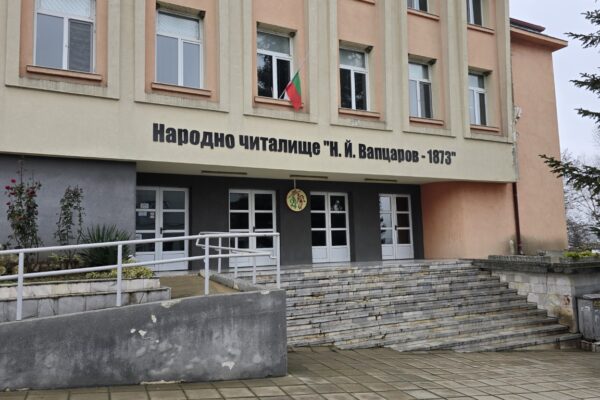
A community center in the village of Belitsa was founded in November 1940 with chairman Todor Rashkov, but it was not registered. On January 28, 1942, a community center “Hristo Botev” was established by protocol, but it was already registered. The community center board purchased a radio in 1944.
The main goal of the community center is cultural and educational activities. Initially, it was housed in private homes, and later in a building of the TKZS – Belitsa village and the Municipality. A library with donated books was also built at the community center. In the mid-1950s, books were purchased for the needs of the library’s readers for the first time.
In 1952, he organized the first live concert with the participation of Pancho Vladigerov in the yard of the new school.
One of the first construction projects in the village, after the village plan was approved, was the community center building. It was started in 1960 and completed in 1963.
In the 1960s it was the main cultural institute in the village of Belitsa, where all amateur artistic activities were concentrated. The chairman was Ivan Ivanov, and the community center secretary throughout the decade was Ivanka Grancharova. In addition to library activities, the library also held readers’ conferences and meetings with writers, conscript evenings, professional evenings, sobriety evenings, etc. The community center also organized clubs, a theater group, a music group, a folk orchestra, a student accordion orchestra, etc.
In 2010, in accordance with the Law on Public Community Centers (PCC), a new Statute was adopted and the community center was renamed the “Hristo Botev-1942” Public Community Center – Belitsa village.
The building that houses the community center is privately owned by the municipality. On the first floor is the dressing room and the cinema with 320 seats and a small rehearsal room with 25 seats. On the second floor is the library; a children’s section, a lending library for adults and a computer room.
The community center operates: the “Young Friend of the Book” club, the “Belichanka” Dance Club, the Women’s Vocal Group, the “Nadezhda” Vocal Group, the “Shrike” Children’s Vocal Group, the “Mini-Shrike” Children’s Vocal Group, the “Shrike” Recitals and Mini Dramatizations and Theater Etudes” Group, and the “Shrike” for Reenactment of Customs.
In 2020, it organized the First National Christmas Star Competition, which was held online. Over 650 children from all over the country participated in the competition, divided into three categories: Making a Christmas Card, My Christmas Story, and My Christmas Song.
A local tourist association “Zdravets” was also founded.
School
“Vasil Levski” Primary School – Belitsa village is the successor to the primary school, which was opened in 1873. It was a solid two-story building with a basement for its time. No data is known about the first teachers.
The building of the first school, according to local recollections, was made of woven walls, the first floor was entered from below, from the river, and the second, from above, from the side of the hill. There were no stairs between the two floors.
In the first days after the Liberation, Petar Stambolov, a native of the village of Pobit Kamak, was invited to become a teacher. He taught children for 30 years, but also taught adults how to cultivate according to agronomic science.
From 1905 to 1908, Bratovan Iliev was a teacher in the village.
After the Inter-Allied War, in the autumn of 1913, the school became Romanian. The building in which the school was housed was half demolished. In 1914, a private building was purchased for the school. In 1916, a new school was built. The construction was carried out by the master builder Todor Gabrovski from Tutrakan.
In 1949, construction of a new two-story building began. In 1952, it moved to a new building, and in 1980, the extension was completed.
A volleyball court was built in the 1970s. In the 1960s, village-wide and municipal cycling competitions were held.
Since 1991 it has been the “Vasil Levski” Primary School – Belitsa village.
Since the academic year 1982/1983, a full-time organization of the educational process has been introduced. By Order No. RD 14-136 of 12. 06. 2007 of the Ministry of Education and Science, due to a permanent trend of decreasing the number of students, as of September 1, 2007, it was closed.
On October 1, 2008, groups from the villages of Shumentsi, Belitsa, Preslavtsi and Tarnovtsi joined the Patilancho Kindergarten. Due to a decrease in the number of children, the group in the village of Belitsa was closed on September 1, 2012.
TCZS
Labor Cooperative Agricultural Farm “Stalin” – Belitsa village was founded on October 22, 1948 by 28 people. The farm block of 860 decares was formed in the Ireka area. A bulldozer from MTS-Glavinitsa came to plow it, and the state provided seeds for planting wheat. In 1949, the first barn for animals was built. In the following years, barns for horses, cows, barns, chicken coops, and pigsties were built. In 1958, everyone entered the TKZS.
In 1958, the villages of Brenitsa, Varnentsi, Shumentsi, Bratomir and Preslavtsi joined the Agricultural Cooperative – Belitsa. As a result of the joining of the villages, the Agricultural Cooperative “Dimitar Blagoev” was formed, and since 1974 a branch of the Agricultural Industrial Complex “Drustar” – Silistra. In 1986, an agricultural brigade was built in the village of Belitsa. In 1991, the Agricultural Cooperative “Dimitar Blagoev – 90” – Belitsa was registered in the village of Belitsa, and in 1992, the Agricultural Cooperative “Izgrev” – Belitsa was registered by Petra Dimitrova Pencheva. Today, the cooperative cultivates about 28,000 decares and continues to develop and be innovative and modern.
The cooperative provides about a hundred jobs, and its social function is one of its priorities. Therefore, in addition to traditional crops such as: wheat, corn, sunflower and rapeseed, we also grow tobacco, fruit trees and pepper in order to provide jobs. The main activities are the production of grain, fruits and vegetables for fresh consumption, production of tobacco, milk thistle, fennel seeds, tobacco, plums.
MONUMENT
The monument to those who died in the wars in the village of Belitsa is located in the center of the village and consists of memorial plaques with the names of the Belitsa residents who died in the wars. It was opened on November 9, 2016 by the mayor of the village Kostadin Manev and the mayor of the Tutrakan Municipality, Dr. Dimitar Stefanov. The author of the monument is the famous master and former national basketball player Valeri Markov from Silistra. A memorial service for the dead is served by Fathers Iliya Tonkov from Tutrakan and Yordan Nikolov from the Ruse diocese. A monument to the deceased prominent figures (25 people) from the village on May 10, 1939 by the Romanian authorities. It is located on the lobbed place near the village.
Prominent personalities associated with the village of Belitsa
Teodosii Spasov – Bulgarian musician, virtuoso kaval performer, Honorary Citizen of the city of Tutrakan. He was born on March 4, 1961 in Isperih, but grew up in the village of Belitsa, Tutrakan Municipality. He graduated from the Philip Kutev Secondary Music School in Kotel and the Academy of Music and Dance Art in Plovdiv. He developed his own, unique style of playing. His performances are an unusual synthesis of traditional folklore, jazz, classical music. In recent years, he has composed film and theater music and works for symphony orchestra and kaval. He has released over 30 CDs with solo performances and with various musical ensembles. In 1995, Newsweek magazine ranked him among the most talented musicians from Eastern Europe. In the “Best of the East” section, it was noted: “Spasov does not just survive in the post-communist cultural wasteland – he creates a new musical genre.” Winner of many honors and awards, including the prize of the International Academy of Arts in Paris (1996), “Musician of the Year” (1997 and 2002), the Apollon Toxophoros Statuette, for his long-standing bright presence in Bulgarian musical life and his successes on world stages (2001), the Film Music Award of the National Film Center (2007), the “Dobri Chintulov” Award for contribution to Bulgarian culture (2009). In 2011, he received the highest award of the Ministry of Culture “Golden Age” for his great contribution to the development and popularization of Bulgarian culture and traditional folklore. Honored with the title “Honorary Citizen of Tutrakan” by Decision No. 898 of the Tutrakan Municipal Council of September 21, 2011.
Sources:
Dobrudzha newspaper, Babadag, No. 13, July 25, 1917; Iliev, Boris. Belitsa, Tutrakansko. S., KPD “Rodno Ludogorie”, 2002. History of Tutrakan. T. 2. 2010; Settlement system of Tutrakan, Handbook, ed. Bulgarreklama, Sofia, 1987; Yordanov, E. From the past of Tutrakan – events and personalities. Ed. Kovachev. 2019; Mutafov, Vl. History of temples in the Ruse district. Part two. S. 2021; Guide to the funds of DA – Silistra (1944–2016). S., 2018; Encyclopedia Tutrakan, T., 2023; Ethnography of Tutrakan, ed. Gutenberg, 2022.