


TARNOVCI
Location – 10 km east of the municipal center of Tutrakan in the direction of Silistra, on the main road Ruse – Silistra.
Old name: Sarı gyol, translated from Turkish to Bulgarian as “yellow lake (puddle)”, after the color of the gyols in the river. Renamed in 1942 in memory of the 6th Tarnovo Infantry Regiment, which participated in the Tutrakan epic in 1916 and fought in the area of the village.
Population according to censuses over the years:
1881 – 275 people
1888 – 436 people
1893 – 610 people
1900 – 417 people
1905 – 408 people
1910 – 446 people
1934 – 262 people
1941 – 265 people
1946 – 367 people
1956 – 478 people
1985 – 429 people
1987 – 430 people
2000 – 467 people
2011 – 378 people
2022 – 286 people
First data
The Archaeological Map of Bulgaria includes Tarnovtsi with an open grave mound in the Razsadnika area. Middle part of a slope of a hill. Altitude 104.45 m. Fields and roadside trees. An abandoned road cuts off part of the eastern periphery of the mound. Diameter about 25 m, height about 2.5 m, traces of property excavations have been discovered.
Tarnovtsi during the Renaissance
According to an extract from an Ottoman register for households, residents, buildings, lands and taxes of Tutrakan and Tutrakanska kaza, according to the old and new census in the village of Sarıkyuli in 1870: 1. Households (inns) – 31. 2. Muslim residents (Turks) – 83 people. Total population – 83 people, according to the old census.
Households (houses) and residents, according to the new census: 1. Households (houses) – 50. 2. Residents of Gypsy origin – 23 Muslims. 3. Residents of Islamic origin (Turks) – 128 people. Total population, according to the new census – 151 people.
According to V. Teplov, there are 1778 Turkish houses in Tutrakanska kas. According to him, villages with a Turkish population in Tutrakanska kas are: Sarıgyol (Tarnovtsi), Enjeköy (Preslavtsi), Karamehmetler (Brenitsa), Arabadjilar (Kolarovo), Akhmatlar (St. Karadzha), Asvatköy (Glavinitsa), Daudjilar (Padina), Emirler (Boil), Kasamlar (Osen), Kovanjilar (Terter), Masutlar (Nozharevo), Uzundje orman (Bogdanci) and others.
Tarnovtsi after the Liberation
After the Liberation, the settlement was included as an administrative-territorial unit in the municipality of Viskoy (present-day village of Tsarevdol), along with constituent villages: Deli Isuflar (Krasnogor, today deleted), Kara Derlar (present-day village of Chernogor), Kuzgun (present-day village of Antimovo) and Chaush Mahle (Sofiytsi, today deleted).
The main livelihood of the local population is agriculture and animal husbandry.
The disastrous results of usury and greengrocery are evidenced by data for the period 1898-1900. At that time, there were 18 “completely ruined” villages in the Tutrakan district. Tarnovtsi was among them.
At the beginning of winter, on December 19, 1899, about 500 farmers, residents of Tutrakan and the villages of Zafirovo, Malak Preslavets, Dolno Ryahovo, Dunavets, Pozharevo, Bogdantsi, Tarnovtsi, Krasnogor, Sofiytsi, Tsarev Dol, Antimovo, Kosara, Bratimir, St. Karadzha, Belitsa, Horozlar flocked to the city. They gathered at the People’s Party club for a protest rally organized by the People’s Party and unanimously protested against the tithe law introduced by the government, because it was “ruinous” for farmers. The participants in the rally urgently asked the people’s representatives to repeal it.
After the signing of the Bucharest Treaty of 1913, the village passed into
After the Allied War and the signing of the Treaty of Bucharest in 1913, it passed into the borders of the Kingdom of Romania. A regime of assimilation of the local population began.
On September 1, 1916, Bulgaria declared war on its “treacherous neighbor” Romania.
The units of the 3rd Bulgarian Army, on September 1st to 2nd, 1916, crossed the Dobrudja border from the Danube to the Black Sea. In 1916, it was a frontline village during the epic battle for Tutrakan.
60-year-old Ali Ch. Ranadzhanov was kidnapped from the village.
The Bulgarian army won the epic battle of Tutrakan, but Bulgaria was a losing country in World War I and on November 27, 1919, the Treaty of Neuilly was signed. Bulgaria lost about 10 percent of its territory and was imposed with reparations and restrictions that were unbearable for the time. Under the Treaty of Neuilly, Southern Dobrudja again became part of Romania. The regime of assimilation of the local population continued.
According to the Craiova Agreement (1940), it was returned to Bulgaria. In the same year, people from Northern Dobrudja from the Tulcan village of Saragyol were settled there.
Tarnovtsi after September 9, 1944
There is information that there is a chapel in the village, built after 1946, which still exists in 1979. According to information, the icons in the chapel are the work of Vitan Konstantinovich or Vitan Dosiuv Koev (Konstantinov) Vitanov (1819 – 1888) from Tryavna. From the preserved protocol book of the Church Board for the period 1941 – 1956 we learn that in 1951 it was decided to purchase a bell for 11,300 leva. At the suggestion of the priest, the Board decided to purchase a church house in the village.
The village was electrified in 1954.
From June 1, 1976, the villages of Tarnovtsi, Tsarev Dol and Antimovo were established as a separate council, the Municipal People’s Council – Tarnovtsi village, and in 1979 it became part of the Tutrakan Municipality.
The main occupation of the population, included in the complex brigade of the Agricultural Complex – Tutrakan, is crop and livestock farming. There is a well-organized sheep farm, a machine yard, playgrounds and dryers.
During the socialist period, the main occupations of the population included in the complex brigade of the Agrarian and Industrial Complex – Tutrakan were crop and livestock farming. There is a sheep farm, a machine yard, playgrounds and dryers. A multifunctional building was built, which houses the City Hall, the Health Service and the Post Office. In 1993, the Tsarev Dol Agricultural Cooperative was founded with its headquarters in the village of Tarnovtsi. After the elections in October 2019, the mayor of the village was Vezhdi Hasan Dail, nominated by the Movement for Rights and Freedoms party.
School
Ivan Vazov Public Primary School – Tarnovtsi village was built in 1933 by the Romanian state. The first teachers were Vesa Angelova Pikova from Tutrakan and Tsvetan Mladenov from Lom.
The building of the public primary school Bulgarian and Turkish school “Ivan Vazov” in the village of Tarnovtsi was built in 1934, consists of two classrooms, one office and one corridor. Bulgarian and Turkish children are educated in the classrooms.
The school closed in 2007 due to a decrease in the number of students.
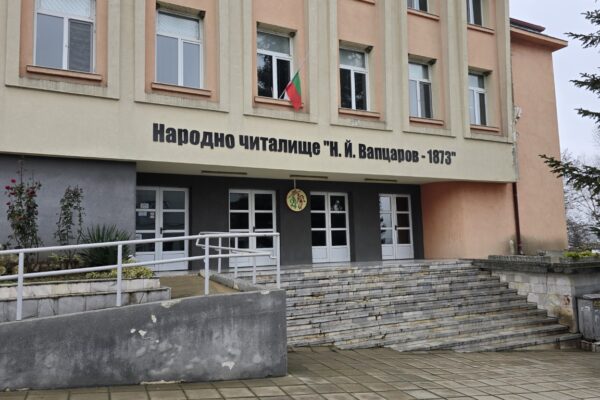
Community center
The “New Life” community center in the village of Tarnovtsi was founded in 1942. It was housed in a private house that no longer exists.
In the years 1965-1966, with the voluntary labor of the village residents and with donated materials from the “Hristo Botev” Tutrakan Cultural and Technical Center, a new building with an area of 315 sq. m was built, with a cinema for 120 people, a dressing room, a large stage, a library lounge and a library.
Before the existence of the primary school, a rich cultural and mass activity developed.
In the years that followed, the community center did not interrupt its activities, the library functioned, holidays and anniversaries were celebrated…
For the development of amateur art, two groups work in the community center – an authentic folklore group of 16 amateurs and a folk dance club. Children’s groups are also organized: a children’s group for performing Bulgarian folk songs; a children’s group for performing pop and old city songs and a children’s group for performing authentic dances.
TCZS
Labor Cooperative Agricultural Farm “Prosperous Life” – village of Tarnovtsi was founded in 1956 at the request of the Initiative Committee in the village of Tarnovtsi with 5600 decares of land. Arif Abilov Adilov was elected chairman, followed by Petar Donev. Radi Radev (uncle Radi) was the permanent host here.
The construction program of the TKZS – village of Tarnovtsi
- 60-head steer – 1956
- Shed for 32 carts – 1956
- Shepherd’s hut for 400 sheep – 1957.
- Pigpen for 100 sheep – 1957
- Chicken coop for 500 hens – 1958.
- Necklace scale, 10 tons – 1958
- Pig barn for 300 pigs – 1959
- Shepherd’s hut for 400 sheep – 1959.
- Calf barn for 80 calves – 1960
- Fence, 200 lin. m – 1961
- Feed mill – 1961
- GSM Warehouse – 1963
- Fertilizer shed – 1967
In 1957, the farm was briefly united with the TKZS – Antimovo village for the purpose of rationalization. In 1959, the labor cooperative farms were united. Tutrakan became the center of the United Labor Cooperative Farm with the following farms – Pozharevo village, Dunavets village, Antimovo village, Tsarev Dol village and Tarnovtsi village.
In 1970, the municipal farms were united into agro-industrial complexes. In Tutrakan, an agro-industrial complex was built with the following united labor-cooperative agricultural farms – Tutrakan, the village of Belitsa, the village of Nova Cherna and the village of Malak Preslavets. In 1976, the small agro-industrial complexes were liquidated and the District Agro-industrial Complex “Drustar” was created. In 1984, agro-industrial complexes were established by municipalities. In the TKZS Tutrakan remained until 1990. In 1991, it again worked independently as the TKZS “Angel Kanchev 91” – the village of Tarnovtsi. In 1992, it changed its status from a TKZS to the ZPK “Angel Kanchev 92” – the village of Tarnovtsi, which after a few months was declared in liquidation until its final liquidation in 1995.
Sources:
Dobrudzha newspaper, Babadag, No. 10, July 18, 1917; Mutafov, Vl. History of the temples in the Ruse diocese. Part two. S. 2021; Tarpanov, V. Chronicle of the troubled times in the national economy of Bulgaria (1944-2017). Memories. Tutrakan. 2018.
YES – Silistra, f. 351, f. 503
https://libsilistra.bg/index.php/10-2017-02-08-13-49-00/912-2020-11-27-12-56-49.html
https://chitalishta.com/index.php?act=community&do=detail1&id=66178
https://www.nsi.bg/statlib/bg/lister.php?iid=DO-010000010&page=105