


Tsar Samuil
Location: 15 km southwest of Tutrakan, 2 km from the main road Ruse – Silistra.
Old names: Kyutyukliy. Renamed in December 1934 after Tsar Samuil (997 -1014).
Population according to censuses over the years:
1888 – 1027 people
1893 – 971 people
1900 – 1159 people
1905 – 1358 people
1910 – 1431 people
1934 – 2431 people
1946 –2644 people
1956 – 2668 people
1985 – 2084 people
2000 – 1803 people
2011 – 1398 people
2022 – 1023 people
First data
Excavations have uncovered objects that prove that a Roman military tomb existed nearby.
Tsar Samuil is present on the Archaeological Map of Bulgaria with a settlement in the Polyanata area. Altitude 45 – 50 m. Area about 65 acres, fragments of household ceramics from the Revival period, a clay Turkish pipe were found. Low degree of concentration and even distribution of the finds. There was a Turkish-Circassian village in this place until 1878. Due to the war and after an epidemic, some emigrated, and the rest moved a little further north, where the present settlement is.
The village was founded in the 17th–18th centuries.
Tsar Samuil after the Liberation
After the Liberation, the settlement was administratively and territorially included in the Brushlen Municipality, Tutrakan District.
The achievements and successes of the craftsmen from the Tutrakan region are also evidenced by their presentation at the First Plovdiv Exhibition in 1892. The protocols of the first exhibition list Mumidzhi Sali Hamalov and Zaturla Chakarhasanov – both from Kutyukli – as winners of silver medals for craftsmanship in wooden products.
In 1907, an agricultural association was established in the village. At the beginning of the 20th century, the number of immigrants – Bulgarians from the Balkans – was constantly growing in the village.
After the Allied War, it remained within the borders of the Kingdom of Bulgaria. It sheltered many Bulgarians fleeing the Romanian regime.
Rural municipal government – the village of Tsar Samuil was established in 1920. It includes the village of Tsar Samuil, it is a local authority and management body.
On April 18, 1923, the Borets Consumer Cooperative was founded, and it began operating on January 16, 1926. It was registered in the Ruse District Court in 1924 under the company name Borets Credit Cooperative, with two departments: credit and consumer.
On February 7, 1926, the cooperative had a membership of 54 people. On June 27, 1926, a decision was made for the cooperative to become a member of the General Union of Bulgarian Agricultural Cooperatives. On the same day, a comrades’ court was established to consider and resolve disputes in various minor misunderstandings only between the members of the association. The role that the cooperative developed among its members, almost at the beginning of its existence – around 1930, fully justifies the activity and development of the economic and socio-cultural life of both its members and the village. Agricultural courses, agricultural and livestock demonstrations were opened, and in the field with which the cooperative was located, varietal seeds recommended by the Ministry of Agriculture and State Property were started to be produced. In 1930, the association was a member of the Ruse Agricultural Union.
At the end of 1949, the membership had grown to 148 people, with a share capital of 610,348 leva.
After the Liberation of Dobrudja in 1940, it was included in the Tutrakan District.
After 1944, it was a municipal government and council, it is a body of local government and implements state policy on its territory. It organizes, manages and controls the activities of economic organizations and institutions, takes care of the protection of the rule of law and the rights of citizens. The population mainly professes the Muslim religion.
From 1944 to 1958 it was an independent council, after which it became a proxy for Nova Cherna. From 1970 to 1979 it was an independent council. After the new administrative division of the country in 1979 it became a mayor’s office within the Settlement System and the Municipality of Tutrakan.
In 1947, a medical health center was opened, which grew into a hospital, but due to the liquidation of rural health facilities in 1964, it was closed. In the 1960s, there was a dental office and a maternity hospital with 4 beds, which were served by 1 doctor, 1 dentist, 2 nurses and a midwife. There was also a children’s consultation, which covered children up to 1 year of age and women’s consultations for pregnant women. The same were in unsuitable buildings and in 1978, the EC of the ONS decided at a meeting to purchase 2 private residential buildings from emigrants in Turkey, which were being renovated. There was also a children’s kitchen.
In 1949, a postal telegraph and telephone station was opened, and in 1977, a building was built next to it and an automatic telephone exchange with 200 stations was opened.
On September 7, 1950, the Vasil Levski Labor Cooperative Agricultural Farm was founded with 94 member-cooperators.
In 1949/1950 the village was electrified and sewered, in 1955 a group canal was built on an arable area of 2 decares.
During the socialist period, industry was represented by the production of the Tarpaulin workshop of the Tutrakan Economic Enterprise “Fourth September”. Tarpaulin covers for all types of cars, trailers and inflatable halls were produced.
A nursery for 40 children was built, a kindergarten for 40 children was opened in an attached building. A commercial building was built, which houses a grocery store, a general store and a restaurant.
The issues of public development and sanitation were resolved, and in 1957, 42 acres of parks were created. Then another 22 acres of parks were planted with ornamental trees and shrubs. The street network was asphalted.
In 2013, over 500 residents of Tsar Samuil signed a petition to hold a local referendum on moving to the Slivo Pole Municipality in Ruse Region. Their reasons were proximity to the big city, more jobs, faster processing of documents, and better treatment conditions. However, their petition was not granted.
Community center
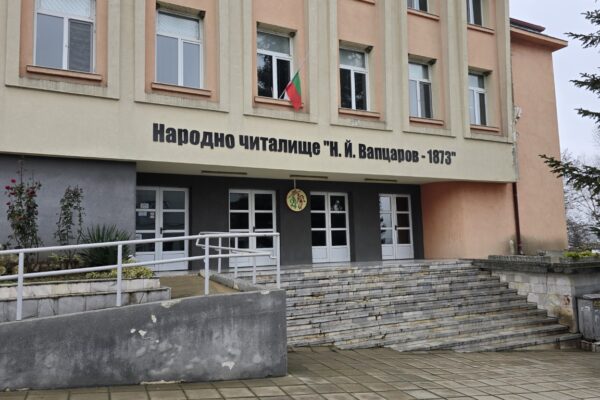
The community center in the village of Tsar Samuil was established in 1928. In 1930, the teacher Boyan Bozhkov named the community center “Iskra” and began collecting books and inventory. Initially, it was housed in a private rented building, and by 1939 – in a room at the school. It had 50 acres of land. From the rent of the land and donations, funds began to be collected for the construction of a building for the needs of the community center. It is a member of the Ruse District Community Center Union, and after the village passed to the Tutrakan District, the community center became a member of the Tutrakan District Community Center Union. Talks, evenings, etc. are organized. There is a library with a reading room. In 1949, the foundations of the community center were laid, which was built in an economic way. The new building was opened on December 19, 1954. The community center has a lounge and a library. The main activity of the community center is the development and maintenance of a publicly accessible library, amateur amateur groups, concerts, exhibitions and local holidays. In 2010, in accordance with the National Library Act, a new Statute was adopted and the community center was renamed the Iskra – 1928 National Community Center – Tsar Samuil village. According to an information card for 2019, the following operate at the community center: Club “Young Friend of the Book”, Club “Bulgarian Embroidery”, Dance Club “Harmony”, Folklore Group “Iskra” and Children’s Vocal Group.
Church
In 1930, the church board in the village and the parish priest Savva Kirchev sent a request to the Metropolitanate, in which they explained that the Turkish population of the village had a prayer house, and 130 refugee Bulgarian families who had settled in this village did not have a prayer house. The village is located about a kilometer from the Bulgarian-Romanian border. The Christians asked for a blessing to build a bell tower in the seven-acre churchyard fenced with wire. The board ordered a bell weighing 100 kg. For many years, the laity rang the bell without having a temple.
On December 16, 1937, a village assembly was held, at which a committee was elected to build a church in the village.
In 1958, the Church Board decided to build a chapel in the village, which would require 50,000 bricks, 50 cubic meters of sand and quarry stones for 15,250 leva.
On December 19, 1997, the first Church Board of Trustees was elected, with Rev. Georgi Georgiev as chairman.
The foundation stone of the church “Exaltation of the Holy Cross” was consecrated on April 4, 1996 by Metropolitan Neophyte. The project was developed in 1992 by arch. Malchev from the company “Spring – 90” – Ruse. The building is a single-nave basilica with dimensions: length 17 m, width 9.50 m and height 7.50 m. The bell tower on the western facade is about 10 meters high. The church was built by “Domostroene” AD – Ruse. In the fall of 2003, the church was completed in rough construction.
School
According to an Extract for the Tutrakan District from Statistics of Primary Schools in the Principality of Bulgaria, in the school year 1899/1900, there was one Turkish school in the village with 90 students.
In 1906, for the first time, a school with 23 children was organized by the local government with the newly arrived teacher – Todor Dimitrov from the city of Ruse. He taught until 1909. A private home ceded to Iliya Gaidarchev was used for the education of the children. From 1909 to 1913, Nikolina Kuyumdzhieva from the city of Razgrad was appointed as the head teacher. Two years later, the functions of the head teacher were performed by Neda Petrova – 1913 – 1914. From 1914 to 1920, Konstantin Petkanov from the village of Brushlen was the teacher, and from 1915 to 1920, the education of students from the first to the fourth grade was led by Konstantin Simeonov. From 1920 to 1945, Boyan Bozhkov and his wife Maria Alexandrova left a deep mark in the educational work. During this period, a private Turkish school was also opened in the village. Rahim Feradov, Husein Hasanov and Suleiman Osmanov worked there as teachers. 1911 The Kyutyukli Primary School had its own seal. In the school year 1923-24, the head teacher was Ivan Petkanov, and the teachers were Boyan Bozhkov from Razgrad, Vasil Hristov from Ruse, Ivanka Petkanova from Antimovo/Tutrakansko/, Anastasia Ilieva from Ruse. By protocol No. 11 of October 1924, the school board decided to take the finished plan of the school from the Ruse district engineering department, and on February 20, 1925. The Municipal Council of the Kyutyukli Municipality, together with the school board, decided to take out a loan for the construction of a primary school building according to a special plan approved by the Ministry of Public Buildings with four classrooms and three smaller rooms for other needs of the school, taking into account that the current school is private. It was decided to take out a loan from the Bulgarian Central Bank in the amount of 600,000 leva. On 26. 01. 1925, a plan for the construction of the school was made, approved by the Ministry. On 19 May 1926, at a meeting of the school board consisting of: Ivan Ganev – chairman, Stefan Kolev – member, Marin Iliev Gaydarchev – member, Yordan Mihov – member, Stoyan Aikaryev – member, a decision was taken to build a massive school building. On 28 July 1926 – the first stone of the school was laid. A priest from the village of Babovo was called to consecrate the newly built school. The construction of the school lasted 144 days – from 06.07.1926 to 26.11.1926. With Protocol No. 9 /1926, the school board proposed a name for the newly built school. The head teacher Boyan Bozhkov proposed that the school be named after Stefan Karadzha. The Ministry of Public Education, with order No. 14 of 05.01.1927, allowed the newly built school to be named “Stefan Karadzha”. The first bell of the newly opened school was purchased by Nedyu Mitev from the village of Kyutyukliy for 400 leva.
At the end of December 1959, the two schools – the Turkish and the Bulgarian – were merged. The principal of the merged school was Stoimen Dimitrov. Students from first to fourth grade were educated in the building of the former Turkish school, and in the other school – the children from the junior high school course. The two buildings of the school were repeatedly rebuilt and expanded. In 1987, a fire broke out and a large part of the building was burned down. On September 15, 2002, the new building of the school was solemnly opened. Since 2012, the school has had merged classes.
On October 1, 2008, by Decision of the Municipal Council, two additional groups were added to the ODZ “Polet” – from the kindergarten in the village of Tsar Samuil. Since the beginning of the 2014/15 school year, due to a decrease in the number of children, one of the out-of-school groups in the village of Tsar Samuil has been closed.
Turkish school
Turkish National Primary School – Tsar Samuil village was founded in 1900, with only two classrooms. In 1919, a teacher teaching Turkish was appointed. In 1921, they began teaching for the first time under a program with regular classes from grades I to IV, and from 1947 to grade VII. In 1960, the Turkish and Bulgarian schools merged.
TCZS
The Vasil Levski Agricultural Farming Association – Tsar Samuil village was established in 1950 with 93 farmers, who by the end of the year had grown to 139. Vasil Stoyanov Babovoliev was elected chairman. At the end of 1957, the number of members became 205, and the land – 8600 decares. At the beginning of 1958, the farm merged with the Georgi Dimitrov Agricultural Farming Association – Nova Cherna village and became the Georgi Dimitrov Agricultural Farming Association – Nova Cherna village. In 1974, the farm transferred to the Agricultural and Industrial Complex /APK/ – Tutrakan as a Complex Brigade until 1987, when it was established as an independent Agricultural Brigade (SSB) – Tsar Samuil village. In September 1992, the brigade was declared in liquidation, until its final liquidation in 1995. The land has been returned to its owners.
Today, agricultural land is cultivated by private farmers.
Sources:
Mutafov, Vl. History of the temples in the Ruse diocese. Part two. Ed. Kovachev. S. 2021; History of Tutrakan. T. 2010.; Encyclopedia Tutrakan. Ed. Gutenberg. 2023.