


VILLAGE OF VARNENTSI
Location – located about 15 km south of the municipal center Tutrakan and 64 km northeast of the regional center Silistra. It is located on a small hill with many water sources.
Old name – Daptyklar, Denizler, (translated from Turkish as “seas”), Dinizler. Renamed in 1942, in memory of the 31st Varna Infantry Regiment, which participated in the Tutrakan epic of 1916 in the region. It annexed the village of Dabravitsa.
Population, according to censuses over the years:
1881 – 717 people
1888 – 791 people
1893 – 830 people
1900 – 1098 people
1905 – 1201 people
1910 – 1247 people
1934 – 1182 people
1941 – 1048 people
1946–1198 people
1985 – 571 people
1987 – 630 people
2000 – 528 people
2022 – 252 people
First data
The village of Varnentsi is present on the Archaeological Map of Bulgaria with 1. A settlement in the Daptaka area. It is located 2.9 km with a 28 ° azimuth from the city hall. Valley slope. Altitude 90 – 115 m. Level. Area of the site about 60 acres. Pottery from the Bronze and (or) Iron Age – small fragments of vessels made by hand are uncharacteristic. The finds are of low concentration and uniform distribution.
2. A settlement in the Daptaka area, which is located 3.5 km away with a 35 ° azimuth. Valley slope with southern exposure. Levels. Area of the site about 40 acres. Finds: pieces of clay wall plaster; shards of vessels from the 8th – 10th centuries. Uncharacteristic fragments of thick-walled vessels, made by hand, which generally relate to prehistory.
3. Grave mounds and one grave mound in the Doychinovtsi area, which is 1.5 km away with a 169° azimuth. Levels Hilltop, 127 m above sea level Diameter 55 m, height 0.70 m.
It is assumed that the village of Varnentsi was founded around 1260 – 1300 in the Daptyk area, from where the old name of the village Daptyklar comes from, about 2 km northeast of the current village. The village was located on a steep bank and a spring flowed at its foot. According to local legends, during the Russo-Turkish War (1768 – 1774), the inhabitants of the village moved to a new place because there were many killed and a plague epidemic broke out, which took the lives of many people. At the same time, many Circassians traveled, who attacked the population and stole animals. The unfavorable living conditions, epidemics and banditry forced them to emigrate. The villagers burned their old settlement and looked for a better place to live. They were led by Deniz Olu (Deniz in Turkish means sea, ollu – leader, chieftain), who gave the new village its name – Denizler. He chose a small hill as the location to protect the village from floods and other disasters.
Neighborhoods were formed in the village depending on the ethnic composition: Bulgarian, populated by Bulgarian Christians; Turkish, populated by Muslims, and Kazalbashka, populated by Muslim immigrants.
The village of Varnentsi after the Liberation
After the Liberation of Bulgaria, Denizler was one of the villages with a mixed population (with a predominance of Bulgarians). In terms of the average number of sheep and goats per household, Denizler residents owned more than the others. This is probably due to the prevailing trend in the Ruse region for sheep breeding to be a priority livelihood for the Bulgarian population.
After 1878, Denizler had 63 houses. The village was administratively included in the Tutrakan district. In 1911, it was a municipality of Denizler with constituent villages: Belitsa, Daydar and Meshe mahle. The municipal council takes care of the public welfare of the municipality. It is an elected body, elected by the population for a certain period of time, it elects the mayor and assistant mayor.
At the beginning of the 20th century, a mass settlement of Bulgarians from the Balkans began. Several Balkan families moved to Denizler.
On May 2, 1904, the people of Denizli founded the Mutual Credit Agricultural Society “Niva”, which provided assistance to poor farmers in order to overcome their dependence on the famous moneylender P. Keremidchiev. The most active figures of the society were: Ivan Stoyanov and Petko Peyuv, who were also its founders.
After the signing of the Bucharest Peace Treaty of July 28, 1913 and the passage of Southern Dobrudja into the Kingdom of Romania, the school and community center in the village of Denizler were closed. The Bulgarians from the village did not want their children to attend a Romanian school. The teacher Berengi secretly gathered the parents and persuaded them that he would teach in Bulgarian, but the Romanian authorities found out and arrested the teacher. A gendarmerie post was established in the village.
In the period 1914-1916, construction of the Tutrakan fortified camp began, according to a project by French and Belgian military specialists. The local population provided free labor for its construction. One of the 15 fortified points was near the village of Denizler.
The units of the 3rd Bulgarian Army, on September 1st to 2nd, 1916, crossed the Dobrudja border from the Danube to the Black Sea. On September 5th and 6th, 1916, the epic battle for the Tutrakan fortress took place. Bulgaria won the battle for Tutrakan, but lost the First World War.
In early December 1917, the residents of the villages of Varnentsi, Meshe Mahle and Shumentsi complained to Minister Tonchev that the Romanian authorities “systematically did everything to depopulate their villages”, asking him to intercede before the Brest-Litovsk Conference to compensate the peasants, “so that Romanian stupidity, barbarity and dishonor would not go unpunished”.
In 1918, after the Second Dobrudja National Assembly in Babadag, with the help of the teacher Petrana Ivanova, he managed to organize the opening of Bulgarian schools in the Tutrakan district, including the one in Denizler.
On January 2, 1919, the population of the villages of the municipalities of Staro Selo, Varnentsi and the village of Shumentsi gathered in Staro Selo and protested “before the English commandant there, that by population it is Bulgarian and in no way do they want to have a Romanian administration” (it is explicitly stated that the population is Bulgarian, because on December 3, 1918, the English commandant of Silistra, Colonel Matthews, obviously manipulated by Romanian propaganda, ordered the Bulgarians from the Silistra district to emigrate by December 8). On January 3, about 4,000 people from Tutrakan and, led by priest Byanov, villagers from Varnentsi, Antimovo, Belitsa, Dunavets and Shumentsi gathered on the heights near Tutrakan. They presented the English commandant in the city with a resolution – a protest, signed by 2,000 people, demanding that the Bulgarian administration be restored in the city and the district, that Bulgarian schools not be closed, and that Bulgarian priests be allowed to serve in the churches.
On November 27, 1919, the Treaty of Neuilly was signed. Bulgaria lost about 10 percent of its territory and was imposed with reparations and restrictions that were unbearable for the time. Under the Treaty of Neuilly, Southern Dobrudja became part of Romania.
After Denizler fell under Romanian occupation, a separate “colonial” or “Vlach” neighborhood was formed, as thousands of Romanian families were settled throughout Southern Dobrudzha. The colonists settled in the vacated Dobrudzha houses confiscated by the Romanian authorities. A regime of assimilation and violence against the local population continued. V. “Dobrudzha” in issue 26 of 1926 describes the following case with two residents of the village of Varnentsi: “From the village of Denizler on May 12, Captain Popescu took the Bulgarians Dragan Georgiev and Kalin Velikov in his car, took them to Sarsanlar and handed them over to the gendarmes to “forward” them to Silistra. In the area of Kalnezh, 18 km from Silistra, the convoy removed the two villagers from the car and killed them. One of them was seriously injured, and before his death he told the Silistra judge and prosecutor about the crime.”
Only between August 15 and September 5, 1928, 820 families from the villages of Tsarev Dol, Varnentsi, Zafirovo, Malak Preslavets, Belitsa, etc. submitted an application to the Durostor District Prefecture and received permission to emigrate.
Ivan Dyako(c) Varbanov was the chairman of the temporary municipal commission in the village of Denizler in the 1930s.
On September 7, 1940, the Treaty of Craiova was signed, by virtue of which Southern Dobrudja was returned to Bulgaria. An exchange of equal numbers of Romanian colonists from Southern and Bulgarians from Northern Dobrudja was envisaged. This exchange was to be carried out within three months. On September 21, the Dobrudja population enthusiastically welcomed the Bulgarian army.
Tutrakan district was formed on October 23, 1940 within the Shumen region by an order of the Ministry of Internal Affairs and Public Health regarding the proclamation of temporary municipalities in the newly annexed territory to Bulgaria – Dobrudzha. It also includes the Municipality of Belitsa, which includes the villages of Belitsa, Daydar, Denizler, Meshe mahle. The Municipal Council takes care of the public welfare of the municipality. It is an elected body, elected by the population for a certain period of time and elects the mayor and assistant mayor.
After the signing of the Craiova Treaty, the demographic picture of the Bulgarian population in Tutrakansko was enriched and supplemented. Bulgarians from Northern Dobrudzha settled in Varnentsi, most of whom were Balkanists and Thracians who had settled there after the war of 1828-1829 and the Dibich-Zabalkanski campaign.
Village of Varnentsi after September 9, 1944
After September 9, 1944, it was a municipal government and council with constituent villages Shumentsi and Dabravitsa. By Decree of the Council of Ministers No. 148/promulgated on May 29, 1956, the village of Dabravitsa was deleted and annexed as a quarter of the village of Varnentsi.
The village was electrified in 1952-1953, and the sewerage system was installed in 1965-1966.
After 1959, he successively held the position of representative of the SONS – the village of Belitsa and the village of Shumentsi, and since 1987 he has been the mayor of the Tutrakan Municipality.
The main livelihood of the residents of the village of Varnentsi, during the socialist period, was agriculture – crop and livestock farming. There was a field unit, a machine park and a livestock and feed complex with a sheep farm and a fattening farm.
In 1946, a dairy was opened in the village, which worked for the Serdika Factory in the town of Silistra. It produced dairy products – milk, cheese, yellow cheese, etc. The enterprise was closed in 1985.
Paramedic Health Center – Varnentsi village was opened in 1959 to provide rapid and specialized medical care to the population. It was closed in 1967.
In 1968, the “Kamashit” workshop was opened. At first, only nylon demijohns were produced, and later products made of papyrus and wicker were also produced. They also produced children’s toys, bags and baskets. The production was intended mainly for export to Cuba, Iran and other countries. The workshop was closed in 1985.
In 1988, a workshop was opened at the Slavyanka factory in Tutrakan. The workshop has two twisting machines and two twine bobbin machines.
Some of the village residents work in large industrial enterprises in Tutrakan – PGU “Terma”, “Istar” plant, “Slavyanka” plant, etc. Workers’ buses are provided by the enterprises to transport workers from Varnentsi and the surrounding villages.
The current town hall and post office building was built in 1971. In 1989, a new public building was opened, housing a textile shop, a pastry shop, a pensioner’s club and a banquet hall.
The village of Varnentsi is famous for its two caves, which are located in the Peshterlika area (4 km southwest of the village); the blooming peonies in May gather the population for recreation and sports.
Church
The spiritual work began before the Liberation of Bulgaria. Before a church was built in the village, a small house donated by Grandpa Dobri from Denizler was used for such a church. In 1868, an Orthodox church was erected, but its dome fell and it had to be rebuilt. The current building of the church “St. Haralampiy” was built in 1871, with funds voluntarily collected by Christians and with their unpaid labor. The first founders, Grandpa Dobri and Grandma Stoyana, gave a place for the construction of the church, on the condition that they be buried in its yard. The church is small, single-nave, with walls built of bricks and mortar, which were later additionally strengthened in the foundations with cement.
The church was consecrated on February 10, 1871. The bell tower is separate from the temple. It is modest, built of rails. The iconostasis is paneled. The icons were painted by iconographer Mitko Tsonkov from Tryavna in 1871.
After the return of Southern Dobrudja to Bulgaria in 1940, the lack of baptism registers for the periods 1913 – 1918 and 1936 – 1938 and marriage registers for 1896 – 1932 was established.
In 1968, the church was supplied with water and in 1971 it was electrified. It was declared an artistic monument of culture in 1979 and an architectural monument in 1983.
The church was robbed in 1993. Two lamps and a candlestick were stolen. On February 10, 2011 – the day of St. Charalampius, with a solemn liturgy celebrated by the Metropolitan of Rousse, Neophyte, the 140th anniversary of the consecration of the temple was celebrated.
The holy monastery still functions today.
School
In 1873, a school was opened in the village. According to the memories of the local residents, teacher Nikola came to the village as a young man from the village of Araplar (present-day Aprilovo), Popovo region, married a girl from the village and collected funds to build a school and a church. The building in which the children were educated was next to the church building. Grandfather Dobri and his wife provided funds for the construction of a school by providing a place with a house built on it.
In the second half of 1874, encouraged quarrels broke out between Muslims and Bulgarians in the village of Denizler regarding the completion of the school construction. One of the village leaders, Ivan Varbanoglu, apparently dissatisfied with the way it was being built, incited the local Muslims to oppose the opening of a Bulgarian school. Bishop Kliment Branicki arrived in Tutrakan and summoned the village leaders. Apparently the problem was resolved. Then he met with the kaymakama, who told him that if the difficulties came from the Muslims, they no longer existed.
Returning to Denizler, Grandpa Ivan again incited the Muslims to expel the Bulgarians from the construction site. This time, Father Dragan, a member of the Board of Trustees of the Mixed Kazalian Council in Tutrakan, also supported Ivan Vrbanoglu. He accused its members of violating Articles 82 and 83 of the Statute.
In 1913, the village fell under Romanian rule, as a result of which the school was closed by 1921. The Bulgarians refused to let their children study in a Romanian school.
On January 12, 1959, a village assembly was convened in the community center hall, where a unanimous decision was made to build a school for students from grades 1 to 8.
In 1974, the Hristo Botev School changed its status from a primary school to a boarding school. It educates children up to primary education. These are children from socially disadvantaged families, without parents, with behavioral disorders. Children from the village also study there. In 1986, a third floor of the school building was built, with the aim of using it as a dormitory. At the beginning of the 20th century, children from Varnentsi were redirected to study in secondary schools in the town of Tutrakan.
Today, the Social and Pedagogical Boarding School (SPI) “Hristo Botev” village of Varnentsi is a special school, in which only boys who have committed antisocial acts are accommodated by court decision. The boarding school carries out correctional and educational work so that after completing primary education, these boys can successfully reintegrate into society. In the SPI – Varnentsi, in addition to mandatory classes, the boys are actively involved in sports activities. Over the years, the graduates of the boarding school have won over 100 medals from regional and national championships in wrestling, track and field, etc. And in the last few years they have been absolute regional champions in table tennis and represent the Silistra region at national championships. Work activity also has a strong educational impact. The boys from the boarding school take care of orchards and vegetable gardens, the produce of which is consumed by them themselves. They also take care of a number of exotic animals. Students also gain knowledge and skills in first aid, drama classes, and much more. “The motto of SPI-Varnentsi is: “WE CAN AND WE DO IT.” The director of the boarding school is Angel Roybov.
Community center
In 1904, a community center was founded under the name “Niva”. It gathered the most active and alert people from the village. With the entry of the Romanian authorities into the territory of the village in 1913, the gathering of more people in one place, the supply of Bulgarian literature and other materials was prohibited, as a result of which the community center activity was suspended. More courageous and alert residents of the village secretly gathered for discussions about the problems of the village and the community center and read newspapers secretly brought from Bulgaria.
On September 21, 1940, the community center activity was restored, a community center board of trustees was elected and the community center adopted the new name “Svetlina”.
In 1949, a theater group was founded, in which local teachers participated under the leadership of Spas Boevski. The most active theater activity took place in 1955 – 1971.
In 1955, a folklore dance troupe was founded, led by Dimitra Drumeva. During its participation in festivals and competitions, it was the recipient of many distinctions, awards and diplomas.
In 1957, a vocal group was established at the community center, which recreated local customs, including lazaruvane and buenik at local and municipal celebrations, and at amateur art shows. A puppetry group was also founded.
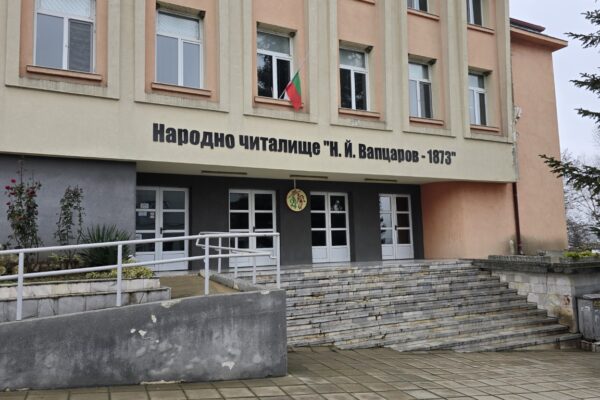
In 1960, a new community center building was built, and the library’s book collection was increased.
Today, the community center has the following educational activities: the “Scruffy Hands” club, the “Iglika” floristry club, the “Magic Needle” workshop, the “Happy Vacation – No. 8” summer camp. It supports the following artistic groups: Authentic Folklore Group “Denizlertsi”, Kukeri Group “Cherni Kukeri”, Children’s Theater Studio “Pastra Vratelezhka”, Dance Group for Original Folklore “Denizlertsi”, Dance Formation “Vesela Zadyavka”, Male Vocal Group “Nastroenie”, Female Vocal Group for Folk Songs “Latinka”, Group for Old Urban Songs “Samakitka” and a caroling group – temporarily.
There is a mobile library for the elderly population.
MUSEUM COLLECTION at the community center – On November 21, 2014, the day of the Christian family, an Ethnographic House Museum was opened. The exhibition is in another, separate building, which was purchased by the community center in 2011. Clothes, costumes, household items and tools characteristic of the life of the village from the last century are exhibited. The exhibits, over 450 in number, were collected and donated by the residents of the village. The museum collection is open to visitors and guests of the village of Varnentsi.
On November 21, 2023, a Visitor Center for Local Natural and Cultural Heritage was opened. The center is located in the courtyard of the Ethnographic House. The center is equipped with interactive exhibits that present the history and culture of the village of Varnentsi.
National Festival of Masquerade Games “Dobrudzhanski Kukeri”
The village of Varnentsi is famous for its black kukeri, which are unique in Bulgaria. According to the Silistra ethnographer Donka Sabotinova, the custom was brought to many villages in Transdanubian Dobrudzha by settlers from Edirne Thrace in the 19th century. It was performed by men and was always associated with the hope for better things. The rites are related to people’s work and their hope for a fertile year.
Their name comes from their characteristic clothing – rags and blackened faces. This is how they scare and drive away evil from people. People believe that if a black cat strokes you – it will bring you luck.
The National Festival of Masquerade Games “Dobrudzhanski Kukeri” is held in the village of Varnentsi after the Cheese Lent as a review of the Kukeri groups, which present traditional Kukeri costumes and rituals. The festival was organized for the first time in 1984, the second edition of “Dobrudzhanski Kukeri” was in 1992, and the third, after a 22-year break, in March 2014, is also organized in 2015, 2023 and 2024.
Organizers are the National Community Center “Svetlina – 1904”, the village of Varnentsi and the Municipality of Tutrakan. The festival has a competitive nature and brings together participants from Northeastern Bulgaria and Romania. The festival is part of the Cultural Calendar of the Municipality of Tutrakan and has a competitive nature.
TCZS
The Dimitar Blagoev Agricultural and Livestock Farm in the village of Varnentsi was established on January 23, 1949. The farm owns 5,456 acres of land, 38 cattle, and 120 sheep. A sheep farm and a cow farm were built. In 1952/1953, there was a piggery. In 1951, the first barn was built, and a year later, the second barn for animals. Six sheds, chicken coops from 1954 and laying hens until 1973. After a bird epidemic, they were closed.
In 1958, as a result of the new agrotechnical and zootechnical measures, the farms of the villages of Belitsa, Varnentsi, Shumentsi, Brenitsa, Preslavtsi and Bratomir were united. OTKZS “D. Blagoev” – the village of Belitsa cultivates 89300 decares of land. Spas Boevski was elected chairman. In 1989, there were four barns with about 400 calves, two sheds with calves and one with cows.
There is a vegetable garden, which is cultivated by one brigade, until 1976 the farm had about 300 decares of orchard. There were vineyards from 1952 to 1963.
From 1970 to 1972, the Agricultural and Rural Development Complex – Tutrakan. From 1972 to 1982, the Agricultural and Rural Development Complex – Tutrakan was disbanded and the brigade was transferred as a section to the Agricultural and Rural Development Complex “Drustar” – Silistra with a branch farm in the village of Belitsa. From 1985 to 1990, the villages of Shumentsi and Varnentsi were united into a Complex Brigade – the village of Shumentsi. In 1990, the village of Varnentsi was separated, and the TKZS “8-mi mart” – the village of Varnentsi was founded, which existed until 1992.
On December 14, 1992, a meeting of the owners of agricultural land was held, at which an initiative committee for the establishment of an agricultural cooperative was elected by protocol. The Agricultural Cooperative “Progress” – village of Varnentsi was founded with 15,600 decares of land. By Decision No. 323 of February 9, 1993, the Silistra District Court registered the Agricultural Cooperative “Progress” – village of Varnentsi. The cooperative mainly deals with the production, processing and sale of agricultural products with guaranteed origin. The crops that the cooperative grows are mainly oilseeds and grains. The products that it sells are the following: – wheat; corn; sunflower; rapeseed; wild dill – fennel; barley; alfalfa.
TEKE
About 0.5 km northwest of the village is the Ali Baba tekke. The monastery was founded in the 17th century and is one of the oldest cult centers, dedicated to the service of the son-in-law of the prophet Muhammad – Ali. Deniz Ali Baba, i.e. the Overseaser, who came from across the sea, Ali Baba, after whose name the village was also called Denizler, is said to have been its founder. It is not known how the tekke from Mustafa Baba in the 16th century became Ali Baba in the 19th century. It is assumed that the old tekke was destroyed and a new tekke of Deniz Ali was rebuilt in its place or nearby, whose tomb is still in it.
There is a folk legend about the healing abilities of Ali Baba, who managed to cure the daughter of Tsar Ivan Shishman. To express his gratitude, the Tsar gave him a plot of land to build a monastery. The Aliani are Muslims – Shiites, influenced by the organization of the Sufi orders of the Bektashis. They moved to the Bulgarian lands in the 30s of the 16th century. The religious system of the Aliani in Bulgaria mixes Turkic, Islamic, dualistic and Christian characteristics.
In the courtyard of the monastery there is a religious building, in which four of the leaders of the monastery during different eras are buried. In the 70s of the 20th century, fulfilling the orders of the Bulgarian Communist Party to destroy religions, the buildings in the monastery were demolished. Only the one in which four spiritual leaders of the Allians are buried is left.
Since 2005, a gathering of Aliani has been organized in May in honor of the healer Deniz Ali Baba.
MONUMENTS – A monument to those who died in World War II was opened in 1962. It is located in the village park and is the work of Kostadin Ivanov.
A monument to those who died in the wars of national unification was opened on September 1, 2018. The steles bear the names of 20 soldiers from the village who died during the Balkan, Inter-Allied, First and Second World Wars. The funds for the erection of the monument were provided by the National Initiative Committee for the Commemoration of the 100th Anniversary of the End of World War I.
Village of Polkovnik Bananovo – Former village in Northeastern Bulgaria, Silistra District. The village no longer exists. OLD NAME, NEIGHBORHOOD – Meshe mahle. Renamed to Polkovnik Bananovo by Decree No. 2191/promulgated on June 27, 1942, renamed to Dabravitsa by Decree No. 107/promulgated on March 13, 1951. By Decree No. 148/promulgated on May 28, 1956, deleted and annexed to the village of Varnentsi.
Prominent personalities born or associated their lives with Varna:
Petrana Ivanova – Teacher and organizer of protests against the Romanian occupation Petrana Ivanova Dunitsova was a teacher in the village of Varnentsi, Tutrakan region. In 1918, after the Second Dobrudzha People’s Assembly in Babadag (September 22-23, 1918), together with the teacher Petar Mavrodinov, she managed to organize the resumption of the educational process in the Bulgarian schools in Tutrakan and the villages of Belitsa, Staro Selo, Varnentsi, etc. near the city. After the second transition of Southern Dobrudzha to Romania and the settlement of the Romanian gendarmerie and administration in the Tutrakan district, in December 1918, the occupying Romanian authorities were greeted with pitchforks, crowbars, and axes in the villages surrounding Tutrakan. At the forefront of the fight against the settling bodies of the Romanian authorities in Tutrakan region were the teachers Petrana Ivanova and Petar Mavrodinov. After the arrival of a Romanian teacher in the village of Varnentsi, she refused to hand over the school to him. Only later, with the arrival of the Romanian gendarmerie, was she forced to give in, but continued to educate the children by organizing a secret evening school. In 1918, she was the chairman of the Dobrudzha People’s Committee in the village of Varnentsi and developed active organizational activities in the surrounding villages of Belitsa, Meshe Mahle, Terter, Shumentsi, etc. At the beginning of January 1919, the population of Tutrakan and the surrounding villages – over 4,000 people, organized by teachers Petrana Ivanova and Petar Mavrodinov, presented a petition to the English commandant with demands for an end to the new Romanian occupation that was beginning, the restoration of Bulgarian schools and churches, and the return of the Bulgarian administration. Despite the commandant’s promises, the occupation became a fact. Petrana Ivanova moved to Tutrakan. She crossed the border with Bulgaria illegally dozens of times to transmit information. She maintained contact with the Dobrudzha organization in Bulgaria and Dr. P. Vichev, who introduced her to Prime Minister Stamboliyski, and she personally exposed to him the desperate situation in Southern Dobrudzha. Because of her activities, she was interrogated by the Romanian authorities in Constanta in 1920 and 1921. Due to the danger of a new arrest, she managed to cross into Bulgaria in May 1921 and settled in Sofia. She married her fellow citizen Nikola Dunitsov. Petrana Dunitsova expressed her civic position in 1940, after the return of Southern Dobrudzha to Bulgaria, in connection with the deportation of citizens from Tutrakan to Romania. She wrote to the People’s Representative Angel Stoyanov in defense of the Tutrakan people, who were trying to convince the Bulgarian authorities not to deport them to Romania.
Sources:
Dimitrova, P. Y. Historical, ethnographic and folklore studies. Silistra, 1989; DA – Silistra, f. 693, f. 78 k, f. 73; History of Tutrakan. T. 2. 2010, p. 89; Napredak, No. 3, January 5, 1941; No. 8, March 1, 1941; No. 9, March 12, 1941; DA – Silistra, f. 58, op. 9, a.e. 7; op. 10, a.e. 4; f. 442, op. 7, a.e. 62, a.e. 72, a.e. 79; School Review, G. XI, books 3 and 4, March and April 1906; Tutrakan Settlement System, Handbook, ed. Bulgarreklama, Sofia, 1987; Iliev, B. From Pozharevo, Tutrakansko to Aprilovo, Popovsko. On the path of the detachment of Tanyo Voivoda from 1876. S. 1996; Iliev, B. Rodno Ludogorie. Almanac. Sofia, 2008; Popov, Zh., Petar Boychev. Chronicle – chronology of facts and events (1913 – 1940). Ed. Kovachev. Tutrakan. 2015; Mutafov, Vl. History of temples in the Ruse district. Second part. S. 2021; History of Tutrakan. T. 2010; Encyclopedia Tutrakan, T., 2023; Ethnography of Tutrakan, ed. Gutenberg, 2022.
https://www.nsi.bg/statlib/bg/lister.php?iid=DO-010000010&page=105